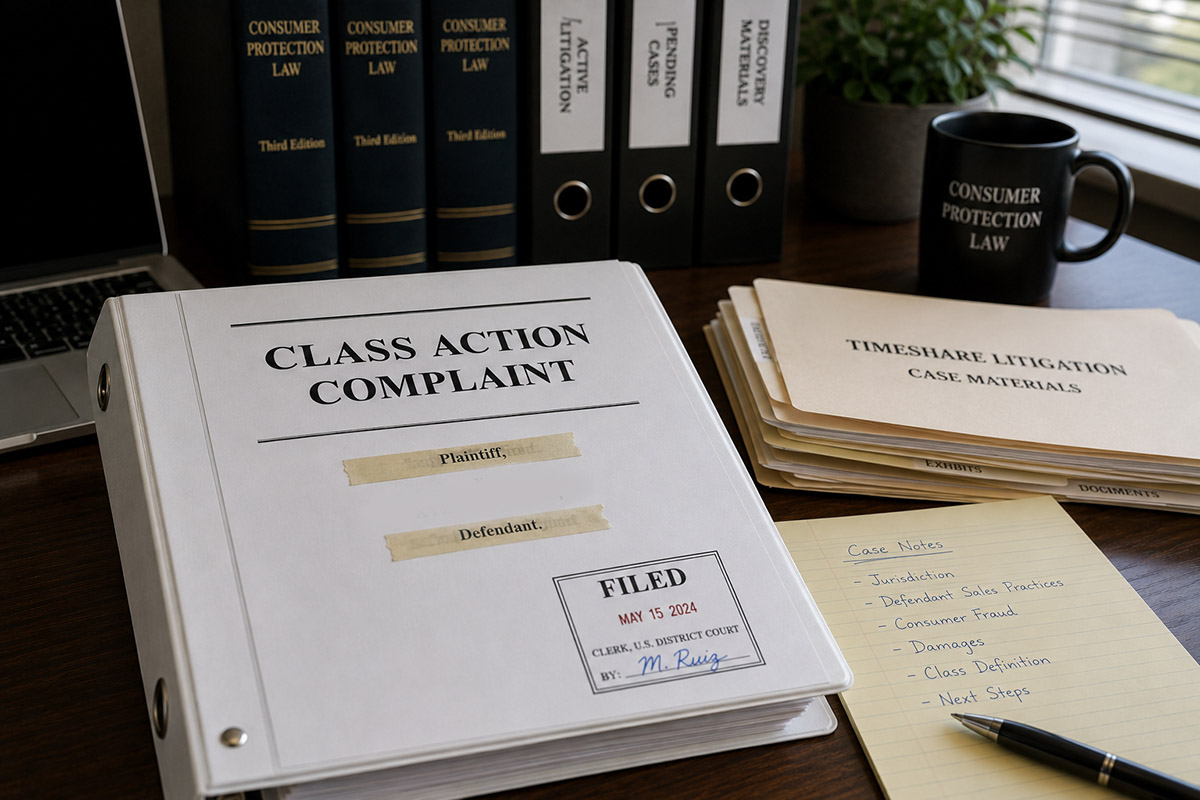
When timeshare owners begin researching their options, many eventually discover news articles or court filings involving their developer. They might see references to class action lawsuits, settlements, consumer protection claims, or ongoing litigation and naturally begin asking the same question.
Does this affect my timeshare?
Sometimes it may.
Sometimes it may not.
The existence of active litigation involving a developer does not automatically determine the outcome of an individual owner’s situation. Every lawsuit is built upon its own facts, legal theories, and evidence. Likewise, every timeshare purchase involves its own sales presentation, contract, financing, and ownership history.
Understanding that distinction is an important first step before assuming that an existing lawsuit either solves or prevents your own legal options.
What Is Active or Pending Timeshare Litigation?
Active litigation generally refers to lawsuits that are currently moving through the court system. Some cases remain in discovery while attorneys gather documents and take testimony. Others involve legal motions, settlement discussions, class certification, trial preparation, or appeals.
Pending litigation simply means the legal process is ongoing and no final resolution has yet been reached.
Within the timeshare industry, these cases may involve allegations concerning sales practices, consumer disclosures, marketing representations, financing, maintenance fees, governance issues, or other contractual disputes. While the specific legal issues differ from one case to another, they often arise from concerns shared by multiple owners.
Why Timeshare Litigation Continues to Grow
The timeshare industry has evolved considerably over the past several decades. Ownership structures have become more complex. Traditional fixed-week ownership has expanded into points-based programs, vacation clubs, upgrade programs, and evolving reservation systems. Along with those changes have come new contractual relationships and new areas of disagreement between owners and developers.
Some disputes center on what consumers believe occurred during the sales presentation. Others involve questions about maintenance fees, reservation availability, ownership upgrades, consumer disclosures, or the administration of resort associations.
Not every disagreement becomes litigation. When legal action is filed, however, courts examine the specific facts, applicable law, and evidence presented by each side.
Why One Lawsuit Does Not Automatically Resolve Every Claim
One of the most common misconceptions among timeshare owners is that a lawsuit involving their developer automatically applies to everyone who owns at that resort.
That is rarely the case.
Some lawsuits involve only a specific group of purchasers during a defined period of time. Others focus on particular sales practices, financing programs, or contractual provisions that may not apply to every owner. Even class action litigation has defined legal requirements regarding who may be included and what claims are being asserted.
Simply owning a timeshare with the same developer does not necessarily mean an owner’s circumstances are identical to those involved in the pending litigation. That is why individual facts continue to matter.
Class Actions and Individual Claims Serve Different Purposes
Class action litigation can be an effective way to address issues affecting large groups of ch2nsumers who experienced substantially similar conduct. At the same time, not every owner’h2 situation fits within a class action.
Some purchases involve unique facts that deserve individual evaluation. Others may involve representations, documentation, or circumstances that differ significantly from the broader issues being litigated. An individual legal review helps determine whether an owner’s circumstances align with existing litigation or whether another approach may be more appropriate.
Neither path is automatically better. Each serves a different purpose depending upon the facts involved.
Think Your Timeshare May Be Connected to Active Litigation?
If your developer has been involved in consumer litigation or you believe your purchase shares similar circumstances, an experienced timeshare attorney can review your ownership documents and explain how those issues may relate to your individual situation.
Litigation Is About More Than Settlement
Consumers often hear that a lawsuit has “settled” and assume the legal issues have been resolved for everyone involved. Litigation is rarely that simple. Some cases settle before trial. Others proceed through years of discovery and motion practice before reaching a courtroom.
Some settlements apply only to certain claims or certain groups of owners. Others require court approval before becoming effective. An experienced litigator understands that settlement is simply one possible outcome within a much larger legal process. The more important question is whether the specific facts of an owner’s purchase support a legal claim independent of any existing lawsuit.
Why Legal Experience is Important
Owners who discover pending litigation frequently begin searching for assistance online. Unfortunately, many first encounter timeshare exit companies that promise quick solutions without ever evaluating the underlying legal issues.
An experienced timeshare litigator approaches the matter differently. Rather than beginning with a predetermined solution, the attorney begins with the facts.
How was the timeshare sold?
What representations were made?
What does the written contract actually provide?
Has similar conduct been challenged elsewhere?
Does existing litigation involve the same developer, the same practices, or similar legal issues? Only after those questions are answered can meaningful legal advice begin.
Final Thoughts
Active litigation involving a timeshare developer may provide valuable insight into broader issues within the industry, but it should never be viewed as a substitute for an individual legal evaluation.
Every purchase is different. Every contract is different. Every sales presentation is different. While one owner’s experience may resemble allegations raised in an existing lawsuit, another owner’s circumstances may require a completely different legal strategy.
Understanding where your situation fits begins with a careful review of the facts, not assumptions based solely on headlines or pending court filings. For owners seeking answers, an experienced timeshare litigator can help distinguish between general industry litigation and the legal issues that may affect their own ownership.
___________________________________________________________________
Disclosure: This article is provided for general informational and educational purposes only and should not be construed as legal advice. Every timeshare ownership and legal matter is unique. Always seek independent advice.
About Finn Law Group: Led by timeshare attorneys Michael D. Finn and J. Andrew Meyer, whose combined legal experience exceeds 75 years, Finn Law Group is a national consumer protection firm headquartered in St. Petersburg, Florida, that focuses exclusively on Timeshare Law. The firm’s attorneys have represented thousands of timeshare owners nationwide in matters involving timeshare cancellations, contract disputes, consumer protection, and litigation. To request a free consultation, call 727-214-0700, email info@finnlawgroup.com, or visit FinnLawGroup.com.